[Case Study]
UMUSE
Creative Media
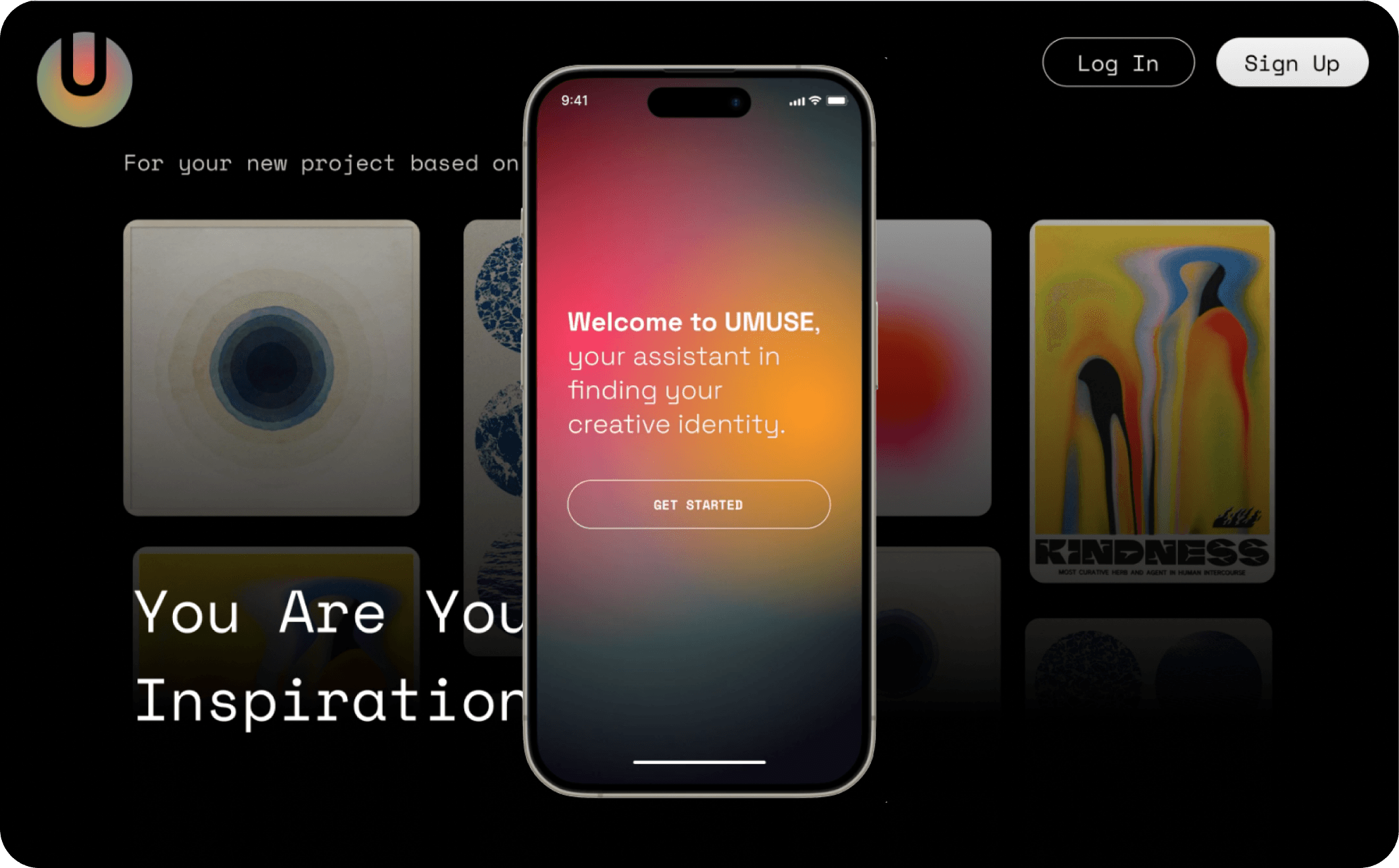
UMUSE
A platform concept designed to inspire creatives across disciplines through a hyper-personalized experience.
Project Overview
UMUSE is a creative media app concept designed to inspire creatives across disciplines through a hyper-personalized experience. As part of a five-person team in USC’s Design for User Experience course, I collaborated on ideation, research, and design for the app.
Problem Statement
Creatives struggle to identify and maintain their consistent style, especially across artistic disciplines and often feel uninspired by generic suggestions for inspiration.
Industry
Creative Media
My Role
UX/UI Designer
Platforms
Mobile App Concept
Timeline
August 2023 - January 2024


Process
(01) User Research
Conducted in-person interviews with our classmates and professor, exploring their creative processes and how they draw inspiration for their creative endeavors.
Informed by the interviews, created a user journey map and an affinity map to highlight the key needs and interests of potential users.
Developed two personas to design for very different users who may benefit from the app.
(02) Insights
Pinterest is the main platform from which inspiration is taken.
Pinterest can feel generic or hard to customize perfectly with too many ads.
An application that personalizes to users through more than just an algorithm based on likes, saves, shares etc. may be beneficial.
(03 Design Solutions)
A "style validation quiz" that allows users to express preferences, assisting in refining style and enhancing the platform’s recommendation accuracy.
An inspiration feed that delivers a curated selection of content that not only matches users' style but also introduces new creative disciplines.
A "Project Page" that enables users to tailor different inspiration feeds by uploading project parameters, ensuring the suggestions align with the specific creative vision for each project.
(04) Testing & Iteration
Created low-fidelity app and web landing page wireframes to be tested.
Conducted usability tests on the wireframes with ten users aged 18–24, via the platform Useberry.
Conducted a feature audit and iterated designs to create a high-fidelity prototype.
User Paint Points & Feature Solutions
Leah struggles to define and grow her photography style. UMUSE Feature: A style validation quiz allows Leah to express her preferences, assisting her in refining her style and enhancing the platform’s recommendation accuracy.
Leah is lost in the sea of generic online content and needs personalized inspiration to navigate creative blocks. UMUSE Feature: A style validation quiz allows Leah to express her preferences, assisting her in refining her style and enhancing the platform’s recommendation accuracy.
Leah struggles to define and grow her photography style. UMUSE Feature: The inspiration feed delivers a curated selection of content that not only matches Leah’s style but also introduces new creative disciplines, broadening her artistic horizons.
Key Learnings
Leveraging User Research to Uncover Needs Without Directly Asking
While conducting user research, I learned that the questions that allowed for the most helpful answers were those that focused on the user’s experience while viewing and interacting with the interfaces rather than hypotheticals about the app. Although it was tempting to ask opinions on potential features or theoretical problems that users could face when in a creative rut, these questions were ultimately too vague and did not allow for reliable and usable answers in return.
Intuitive Design is Subjective
Our user research revealed that what I considered intuitive design was not perceived as such for all. This insight prompted me to enhance clarity across the user journey by introducing elements that displayed a user’s progress and adding a question feature within the style validation quiz flows. These adjustments ensured a smoother, more understandable experience for a wider range of users.